Pipe-Strap vs Clamp-On Temperature Sensor: Which?
Jun 23, 2026
A contractor wiring up a stadium plant room faces the same small decision a hundred times: how to get a temperature off a pipe without breaking into it. Two answers compete. One wraps the pipe with an adjustable strap; the other clamps a metal saddle sized to that exact pipe. They look similar and cost similar. They are not the same buy.
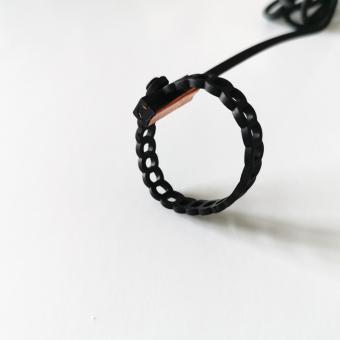
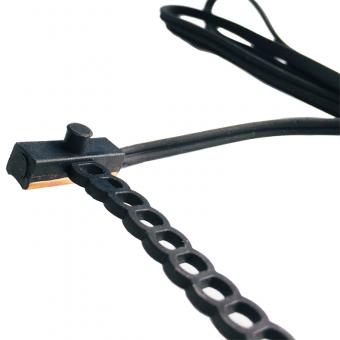
A pipe-strap sensor holds its sensing tip against the pipe with a flexible, self-locking strap. In an overmoulded design — our TPE-overmoulded construction — the NTC element, its epoxy, and the cable are fused into one sealed body. The MFE1 strap runs about 110 mm long and 7 mm wide and fits pipe up to roughly 35 mm OD; an extension chain doubles that. The locking holes on a 4.5 mm pitch keep it from backing off under thermal cycling. One part number, many diameters — see the MFE1 strap sensor with extension chain.
A metal clamp-on uses a spring clip or worm-drive band sized to one pipe diameter, pressing the element into direct metal contact. Fastest heat transfer, narrowest fit.
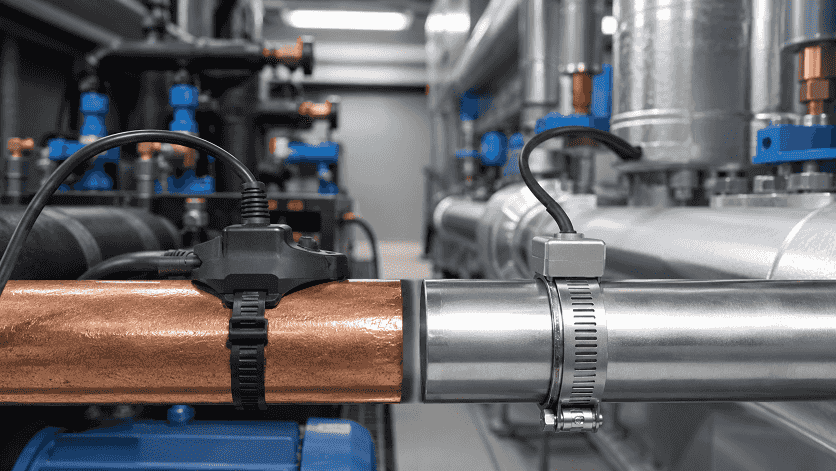
| Attribute | Adjustable pipe-strap | Fixed metal clamp-on |
|---|---|---|
| Diameter fit | One part, wide range (≤35 mm, extendable) | One diameter band per part |
| Thermal contact | Polymer tip, or copper-capped | Direct metal-to-metal |
| Response | Moderate; fast with copper cap | Fastest |
| Ingress (IEC 60529) | Up to IP68 (sealed) | Varies, often lower |
| Install | Tool-free, seconds | Screw clamp needs a driver |
| Best for | Varied or wet pipework | Fixed-size tight loops |
"Strap vs clamp" is really a question about thermal contact, and a strap sensor can close most of the gap with a metal-capped tip. From the MFE1 datasheet, three tip builds trade response against sealing — and copper carries this because its thermal conductivity (~385 W/m·K) is on the order of a thousand times that of TPE:
| Tip | Thermal path | Response | Ingress | Use when |
|---|---|---|---|---|
| Bare TPE (MFE1D) | Polymer only | Moderate | IP68 | Cost matters, response non-critical, may submerge |
| Copper sheet (MFE1F) | Flat Cu interface | Fast | IP68 | General HVAC-R — the default recommendation |
| Copper tube ø4×16 (MFE1U) | Cu deep into body | Fastest | IP65 | Tight loops, defrost; not for immersion |
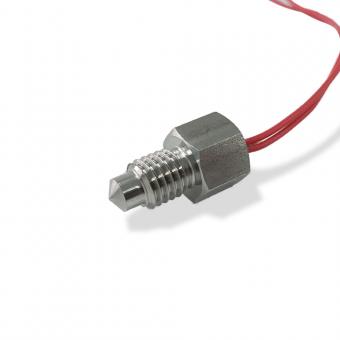
For threaded boiler and water-pipe points where a fitting already exists, a screw-in part like the G1/2–G1/8 pipe sensor (MFP-7) may beat both. Whatever the style, the reading still lives or dies on mounting — see why your pipe sensor reads 8°F wrong. And if nothing in the catalogue fits, both styles customise; the brief is in Article 10. For the bigger system picture, start at the pillar on stadium pipe sensing.
No.1 XiSan Road, Electromechanical Industry Park , High&New Tech.Zone. Hefei,Anhui,China
тел : +86-551-69109668
Whatsapp : +86-13339100504
Эл. адрес : info@focusens.com
Skype : melodyliu520






 +86-551-69109668