KTY84 vs PT1000: what a drive reads when the sensor type is wrong
Sep 20, 2026The consequence is not symmetrical, and that asymmetry is the point of this page:
One failure mode is loud and stops production. The other is silent and removes the thermal protection while every instrument on the panel shows a plausible number.
Siemens has migrated its motors and spindles from the KTY84-130 to a PT1000. The migration document is public, and its wording about the two characteristics is unambiguous: the KTY sensor "is discontinued and no longer available in the market",
the PT1000 is the successor to be used in its motors and spindles, and "the temperature characteristic is not compatible!!!". See Change of temperature sensor KTY84-130 on PT1000.
The same document sets out the transition: delivery of the new configuration from 2016, phase-out from around 2018, product discontinuation in 2020, product cancellation in 2028, with ten years of spare-part availability.
Motors and spindles without a DRIVE-CLiQ interface received new article numbers; those with the interface kept theirs because the sensor type is handled on the far side of the interface.
Affected lines named in the document include SIMOTICS S, M, L and T, the 2SP1 spindles, SINAMICS S and G, SINUMERIK and SIMOTION.
What the document does not do is say how far wrong the reading goes when the sensor and the input disagree. That is a number an engineer needs when a rebuilt motor comes back with the wrong element in it,
or when a spare from the shelf predates the changeover. The rest of this page is that number.
| Temperature | KTY84/130 typical (Ω) | PT1000 per IEC 60751 (Ω) |
|---|---|---|
| −40 °C | 359 | 842.7 |
| −20 °C | 424 | 921.6 |
| 0 °C | 498 | 1000.0 |
| 25 °C | 603 | 1097.3 |
| 50 °C | 722 | 1194.0 |
| 100 °C | 1000 | 1385.1 |
| 150 °C | 1334 | 1573.3 |
| 200 °C | 1722 | 1758.6 |
| 250 °C | 2166 | 1941.0 |
| 300 °C | 2624 | 2120.5 |
KTY84/130 typical values from Table 7 of the NXP KTY84 series datasheet. PT1000 values computed from the reference function in IEC 60751, with A = 3.9083 × 10⁻³, B = −5.775 × 10⁻⁷ and C = −4.183 × 10⁻¹² below 0 °C; the same function produces our PT1000 resistance table.
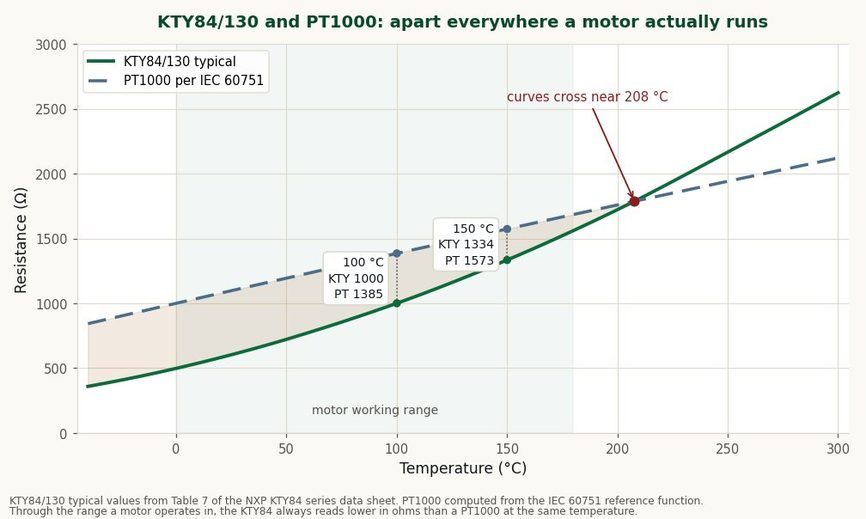
KTY84 values from the NXP data sheet, PT1000 computed from IEC 60751. Through the range a motor actually operates in, the KTY84 always reads lower.
Read down the two columns and the shape of the problem appears. The PT1000 starts high and climbs gently at about 3.85 Ω per kelvin. The KTY84 starts low and climbs steeply, accelerating as it goes.
They meet somewhere above 200 °C, which is above the working range of nearly every motor, so within the range that matters the KTY84 always reads lower in ohms than a PT1000 at the same temperature.
The input applies the IEC 60751 inverse function to a resistance that was never on that curve.
| Actual sensor temperature | KTY84 resistance | Input displays | Error |
|---|---|---|---|
| −40 °C | 359 Ω | −159 °C | −119 K |
| 0 °C | 498 Ω | −126 °C | −126 K |
| 25 °C | 603 Ω | −100 °C | −125 K |
| 50 °C | 722 Ω | −70 °C | −120 K |
| 100 °C | 1000 Ω | 0 °C | −100 K |
| 150 °C | 1334 Ω | 87 °C | −63 K |
| 200 °C | 1722 Ω | 190 °C | −10 K |
Computed by taking each KTY84/130 typical value from the datasheet table and inverting the IEC 60751 function to find the temperature a PT1000 input would report for that resistance.
Two rows decide whether this matters.
At a real 150 °C the input shows 87 °C. IEC 60085 designates thermal class 155 and thermal class 180 for electrical insulation, which correspond to the familiar class F and class H windings (IEC 60085).
A machine at 150 °C in a class F winding is inside its margin but close to it, and an operator watching 87 °C has no reason to look.
By the time the displayed figure reaches an alarm threshold set for a PT1000, say 155 °C, the winding is somewhere above 200 °C.
At room temperature the display is around −100 °C. This is the saving grace of the configuration, because most drives raise a sensor-fault or wire-break diagnostic when a temperature input reads far below any plausible ambient.
Whether the protection is absent or merely a nuisance therefore depends on whether the low-end fault threshold is enabled and where it sits.
That is a parameter worth checking rather than assuming, and it is the difference between a machine that refuses to start and a machine that runs unprotected.
| Actual sensor temperature | PT1000 resistance | Input displays | Error |
|---|---|---|---|
| −40 °C | 842.7 Ω | 72 °C | +112 K |
| −20 °C | 921.6 Ω | 86 °C | +106 K |
| 0 °C | 1000.0 Ω | 100 °C | +100 K |
| 25 °C | 1097.3 Ω | 115 °C | +90 K |
| 50 °C | 1194.0 Ω | 129 °C | +79 K |
| 100 °C | 1385.1 Ω | 157 °C | +57 K |
| 150 °C | 1573.3 Ω | 181 °C | +31 K |
Computed by taking the IEC 60751 resistance at each temperature and reading it back against the KTY84/130 typical curve, interpolating linearly between the datasheet's tabulated rows.
A cold motor reports about 100 °C. A warm one reports 115 to 130 °C. Any alarm threshold set for a motor winding is below that, so the drive trips before the machine turns, and it keeps tripping. Nobody gets hurt and nothing gets built.
This direction is the one people find quickly, because the symptom appears the moment the machine is energised. The first direction is the one that gets found later, and usually by a failed winding.
Disconnect one sensor lead, let the motor sit at ambient, measure the sensor at its own terminals with a thermometer alongside.
| Reading near 25 °C | Element |
|---|---|
| about 600 Ω | KTY84 |
| about 1100 Ω | PT1000 |
Those two numbers are far enough apart that one measurement settles it. A reading near 1000 Ω is neither: that is a 1 kΩ KTY81 or KTY83, or a PT1000 sitting at 0 °C, and the KTY84-130 resistance table and part verification page has the full identification set and the bench procedure.
Then check what the input is configured for, in the drive parameter rather than on the nameplate. A rebuilt or reconditioned motor is the common source of a mismatch, because the rewinder fits whatever element is on the shelf and the drive parameter is never revisited. A spare motor that predates a changeover is the other.
Small in-line modules exist that take a PT1000 element and present a KTY84 characteristic to the drive, allowing a new motor to run on an old parameter set. They work by re-mapping the curve, and they are a legitimate answer to a fleet where the drives cannot be reparameterised.
Three things to establish before specifying one. Its own accuracy, which adds to the sensor's and is not always quoted in kelvin. Its behaviour on sensor open circuit and short circuit, because a module that outputs a mid-scale value when the element fails has removed the drive's wire-break detection.
And whether it is inside or outside the safety function, since a module in the path of a protective channel is part of that channel and inherits its documentation requirements.
Where the drive can be reparameterised, reparameterising is the cheaper and more auditable answer. A module is for the case where it cannot.
A silicon PTC keeps the existing scaling. The Focusens LPTC84-130 is specified against the same R100 reference at ±3%, over −40 to +180 °C. Probe versions are in the FTY series and the EV motor protection variant.
That 180 °C ceiling sits well below the KTY84's 300 °C, so confirm your own maximum before calling it like for like.
A PT1000 is the better long-term choice and is where the drive industry has gone. The curve is defined by IEC 60751 rather than by one manufacturer's datasheet, tolerance classes are standardised, and the part will still be specified in twenty years.
This is what Siemens did. Elements and probes are under RTD sensors, with the background in our RTD guide.
Where the requirement is a trip at a fixed temperature and not a reading, a switching PTC to DIN 44082 and its companion DIN 44081 is a different and usually cheaper device, with a steep step at its rated temperature that a protection relay reads directly.
Our DIN 44081 and DIN 44082 guide has the threshold values and the colour codes.
Neither an LPTC84 nor any other silicon PTC reaches it. That is platinum territory, and IEC 60751 covers thin-film elements to 600 °C.
Mechanically it can be. Electrically it is not, and the drive input has to be told which one it is looking at. Siemens states in its own migration document that the temperature characteristic is not compatible.
Roughly 100 to 126 K low across the motor working range. A winding at 100 °C displays as 0 °C.
A KTY84 element on a PT1000 input, because it under-reads and the alarm never fires. The reverse trips early and merely stops the machine.
No. The error varies from about 126 K to about 10 K across the range, so a fixed offset is wrong nearly everywhere. The input needs the correct curve, not a correction.
Measure at the sensor terminals at a known ambient. About 600 Ω at 25 °C is a KTY84; about 1100 Ω is a PT1000.
No.1 XiSan Road, Electromechanical Industry Park , High&New Tech.Zone. Hefei,Anhui,China
тел : +86-551-69109668
Whatsapp : +86-13339100504
Эл. адрес : info@focusens.com
Skype : melodyliu520






 +86-551-69109668